


The 2018/19 football season ended for PSG with a sense of underachievement once again. Despite comfortably winning Ligue 1 with 91 points, the team crashed out once more in the Champions League, losing on away goals to Manchester United. Their misery was further compounded by defeat to Rennes in the Coupe de France final, despite holding a 2-0 lead. However, their not-so noisy neighbours- Paris FC have had an equally heart-breaking end to their season. Although their story is not so well known.
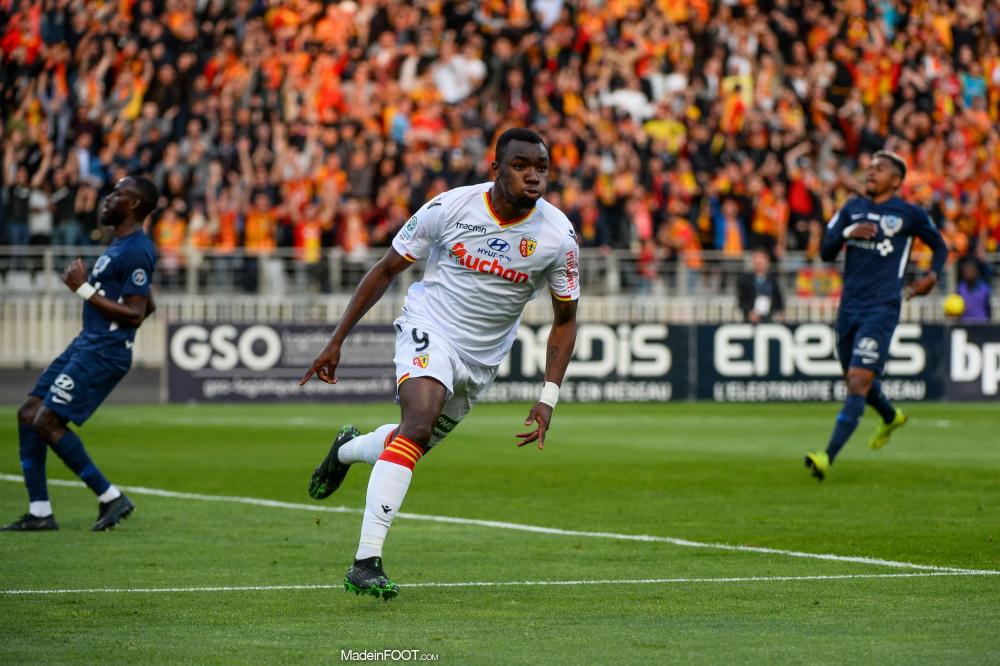
In the Quarter-final play-off for promotion to Ligue 1 Paris FC found themselves 1-0 down to Lens, thanks to a misplaced pass in midfield and an incisive breakaway that resulted in Thierry Ambrose slotting the ball home from 10 yards. However, with seconds to play Paris FC substitute, the Bosnian Marko Maletic, latched on to a flick-on and rifled home from a tight angle to make the score level and keep the Paris FC promotion dream firmly alive. This elation soon turned to despair as they crashed out to Lens on penalties, with Romain Perraud (who is now at Celtic) hitting the right post with his spot kick. Paris FC, literally inches from a possible promotion to Ligue 1, truly displaying the fine lines of football and how a season can be made or broken on one kick. Still, Paris FC should not look back on the previous season with too much gloom. The club finished 4 places better off than the previous season, moving from 8th to 4th and held the best defensive record in the league conceding just 22 goals in 38 games, a record even Atletico Madrid would be proud of. Certainly, their Parisian home, the Stade Sebastien-Charlety, in the 13th arrondissement of Paris, proved somewhat of a fortress, conceding 6 goals in 19 games and losing just once to eventual runners up, Brest. These achievements are not to be taken lightly once analysing the club’s woeful 47-year history.
This brings us back to Paris-Saint-Germain, the football team that dominates Paris. This was not always such a formality, however. In an attempt to propel the quality and audience of football within Paris, Paris FC was launched in 1969. The club then fused with Stade Saint-Germain to form, the infamous Paris Saint-Germain. However, the clubs divorced in 1971, as the mayor of Paris refused to support a non-Parisian club, as they had been situated in the Saint-Germain-en-Laye suburbs. Surprisingly maybe, it was Paris Saint-Germain coming off the worst off out of the two clubs. Paris FC held both its Ligue 1 status and the right to play at the Parc des Princes, whilst Paris Saint-Germain were demoted to the French Third division. So how have the tables turned so dramatically between the two clubs? One factor is the contrasting fortunes of the clubs following the split. Paris FC were relegated after two seasons, whilst PSG gained promotion to the top division in the same year, which also led to their acquisition of the Parc des Princes over Paris FC. PSG have remained a mainstay in France’s top league ever since, although the same cannot be said for their neighbours in the 13th arrondissement.
Ever since their relegation in 1975, Paris FC have only been back in the top division of France for one season. The club was even in the Championnat de France amateur for six years, before their overdue promotion to the National division in 2006. So how did one of Paris’ clubs become a European superpower, whilst her ex-partner struggles in the lower divisions of French football.
Although it is difficult to identify specific points in analysing any club’s progress, there are aspects of Paris FC which have, and continue to hold the club back from its ambition of competing in Ligue 1. The average attendance at the Stade Sebastien-Charlety in the previous season was a meagre 3,849, despite the stadium holding a 20,000 seat capacity. Although an improvement on the 3,072 average attendance in 2017/18, this was only better than six other teams in Ligue 2. Interestingly, Parisian club Red Star FC had the lowest attendance of all teams in Ligue 2, suggesting a deep-rooted problem in the popularity of Parisian clubs outside of PSG. The low attendance seems unsurprising for Paris FC however, when considering their stadium. Stade Charlety has been shared with Stade Francais Rugby Union club, Paris Saint-Germain Rugby League club, Paris Universite Club and Paris Saint-Germain Feminines. The stadium also has an athletic track surrounding the pitch, which dilutes any atmosphere created, and hinders the experience and enjoyment for Paris FC fans watching.
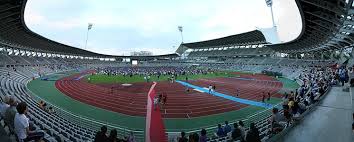
President of Paris FC, Pierre Feracci is open to the idea of renovating the stadium before the club are promoted, although this could be an arduous and expensive process that could see the club selling their key assets in order to keep Paris FC financially stable. Nevertheless, the issues surrounding Stade Charlety do not seem to be taking a hold of the current group of players. The aforementioned solitary loss at home, suggests that last season the team firmly considered their stadium home.
A second issue, which the club have already identified and attempted to resolve is the constant stream of youngsters who have left the club in their early years, leaving for little to no money, and going on to move to big European clubs. In 2018, the club moved into a new training ground in southern Paris, costing 7 million euros. Feracci, as quoted in The Independent stated: ‘We had arguably the worst infrastructure of any Ligue 2 club; now it’s among the best. I think in the next four to five years our training ground will be one of the best in France’. Feracci went on to say, ‘We’ve got four high-quality pitches, including a hybrid, heated one… Orly has added so much energy and vitality to the club.’ How does this help them attract and keep any young talent that they hold? Their professional accreditation from the French Football Association last year allows the club to make better contract offers to young players, so they are less likely to move on in hope of a better deal. Feracci (again in The Independent) lamented that ‘in the ten years I’ve been here, 15 to 20 youngsters between 11-19 have left the club every year… We couldn’t offer professional contracts before the age of 20, and we lost players at a younger age, too.’
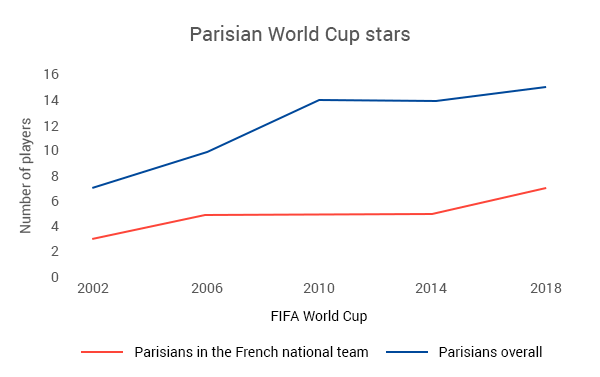
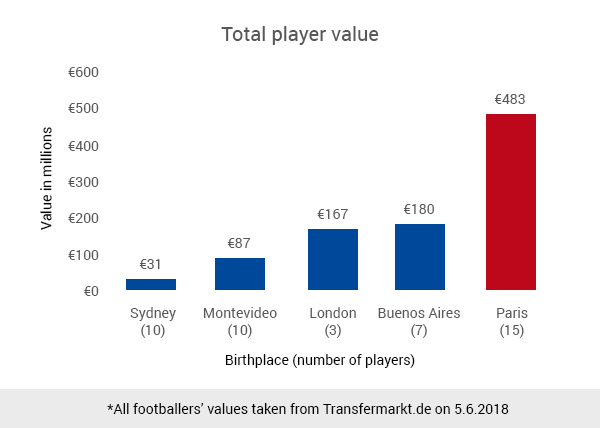
It seems for a club like Paris FC the prospect of young talent is more important than most French clubs. At the 2018 World Cup 52 players were born in France, more than any other country. For example, Mehdi Benatia was born in France, but chose to represent Morocco due to his parents. Out of the 52 players born in France, 15 were from Paris. There has been an increase in the amount of Parisian both in the French team, and Parisians participating at the World Cup between 2002 and 2018. As the graph shows, 3 Parisians represented France in 2002, which increased to 7 in 2018. Similarly, 7 Parisians were at the 2002 World Cup for all countries, compared to 15 in 2019. What is potentially even more enticing for a club like Paris FC is the estimated worth of Parisian talent. Players from Paris at the 2018 World Cup had an accumulative worth of 483 million euros (according to Transfermarkt values- taken 5.6.2018). This is nearly triple the value of what players from London at the World Cup were (167 million euros). Although Paris FC is unlikely to have too many players competing at the World Cup in the near future, they are sure to take optimism from the deep pool of football talent that Paris holds.
Paris FC have seen this Parisian talent first-hand with a number of players starting their career with Paris FC before jetting off elsewhere. Former Liverpool defender and PSG captain, Mamadou Sakho was at Paris FC from age 6-12. Strasbourg right-back Kenny Lala was at Paris FC from 17-19, and Red Bull Leipzig defender, Nordi Mukiele was at the club from age 7-16. These are just a handful of players that Paris FC could not keep hold of, and who left the club for no major profit. Transfermarkt shows the current value of the three players to total 44 million euros, and while it is ambitious to believe that Paris FC would be able to hold on to these players long enough to make that kind of money, it is certainly reasonable to think that the club could have made a healthy profit if they were able to hold on to their assets.

Now, with the professional accreditation from the French Football Association for the clubs new training ground, Paris FC will have a better chance of holding on to their youngsters. The future looks brighter than the past for Paris FC, thanks to their new infrastructure, allowing the club to offer youngsters professional contracts before they reached 20. Their ability to keep hold of youngsters and offer better facilities at their training ground may be the crucial push which propels the forgotten Parisian club back into Ligue 1 after their 40-year absence.


 Incognito Football